
Control and Contrast
Fascist/Anti-fascist: Philip Johnson, August Sander, and Pearl Binder

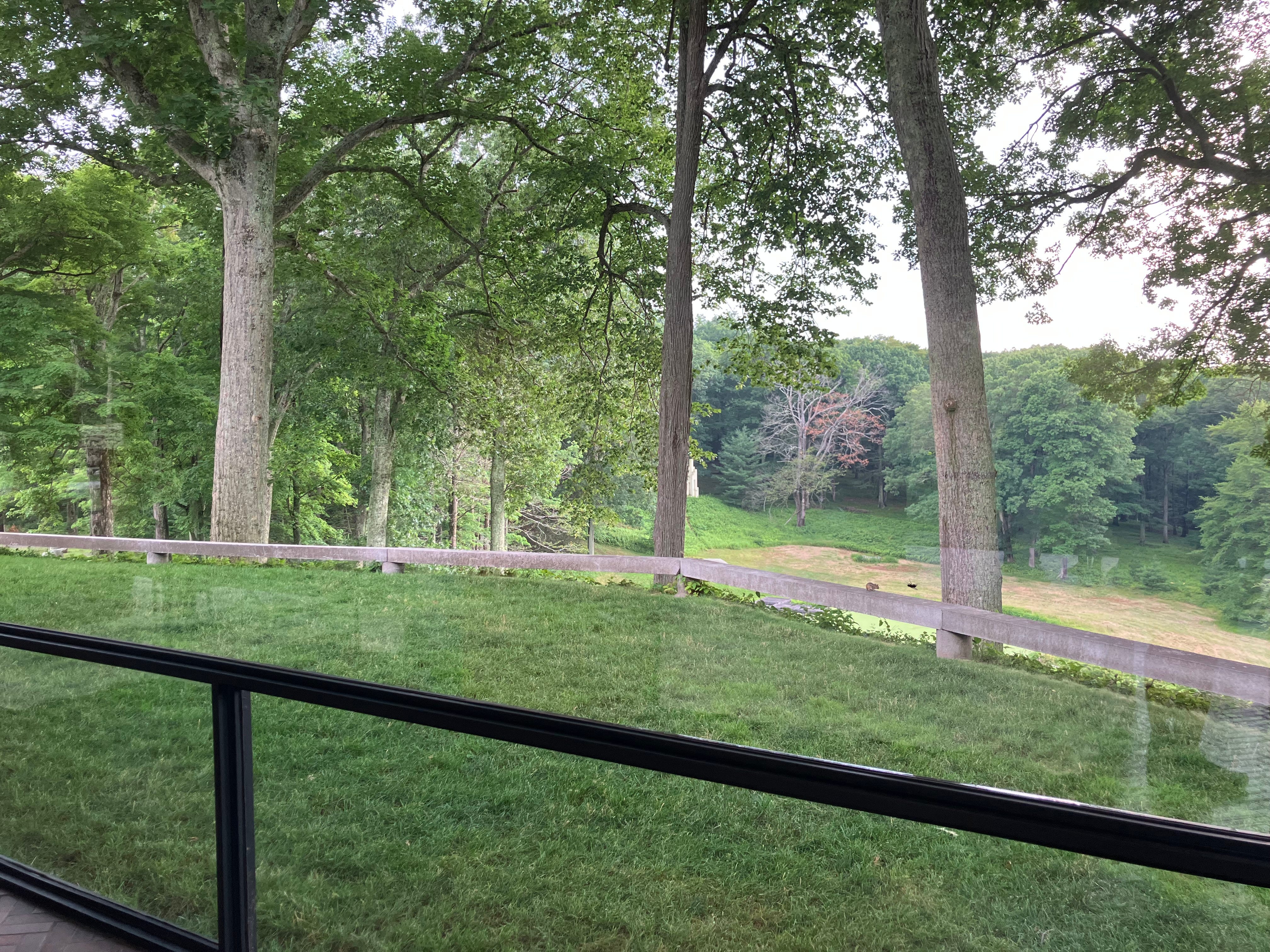
Control
“Philip Johnson was an American architect with a long and influential career. He was born in 1906 and died in 2005. He worked into his nineties. This tour focuses on his professional work but he had a long and complicated life. He was active politically in the 1930s. He believed in fascism, which he later regretted and tried to atone for. I won’t talk about that, but I can if any of you want to. I’m not avoiding it. I’m just not focusing on it. Any questions?”
Last month, I took a day trip up to Connecticut to see an icon of American minimalism: Philip Johnson’s Glass House1. Johnson built the transparent house, and lived in it for decades, as an experiment in radical simplicity. I knew Johnson had a reputation as an antisemite. I didn’t know the specifics. I didn’t ask the tour guide for any more information, though I did wonder about how he atoned. She mentioned that Johnson served in World War II as a late draftee, cleaning latrines. Maybe that was it.
The Glass House feels expansive inside. You are inside and outside at once, but it’s also a controlling and controlled way to live. There is no room for clutter. Don’t try to put anything on the coffee table! (and don’t step on the white rug). Sarah at exhibits in new york complained recently that “minimalism has been lazily deployed to signal good taste” and you can see that here— the assumption that less is always more elegant. Restraint becomes both a moral virtue and an aesthetic guarantee of quality. Johnson’s house is situated on 49 private acres in New Canaan and hosted the cultural elite through the 1960s and 1970s. Andy Warhol left a cigarette burn on the Mies van der Rohe Barcelona chairs.


I enjoyed seeing Glass House— in part because it’s so aesthetically pleasing (the symmetry! the clean lines!) and because it immersed me in an artist’s wholistic worldview. That’s seductive and engaging. But the space also made me uncomfortable. The trees were planted to frame his views and doors are so symmetrical that several are entirely trompe-l’oeil. They lead nowhere. The fireplace smokes. The kitchen wasn’t up to hosting Johnson’s parties, which were catered from another building on site. The Glass House was actually a diptych with a matching Brick House, like a fairytale. The Brick House is less famous, but equally extreme. Its only windows face the back or the sky. There is no parking lot for visitors— you must arrive by van with the tour guide. Johnson didn’t like to see cars and hid his driveway behind a stone wall.
As the group stood in the house the tour guide asked if any of us would want to live there. Most people declined. I wasn’t sure how to answer. It would be interesting to try, I thought. But not home. Not my space, but Johnson’s.
Contrast
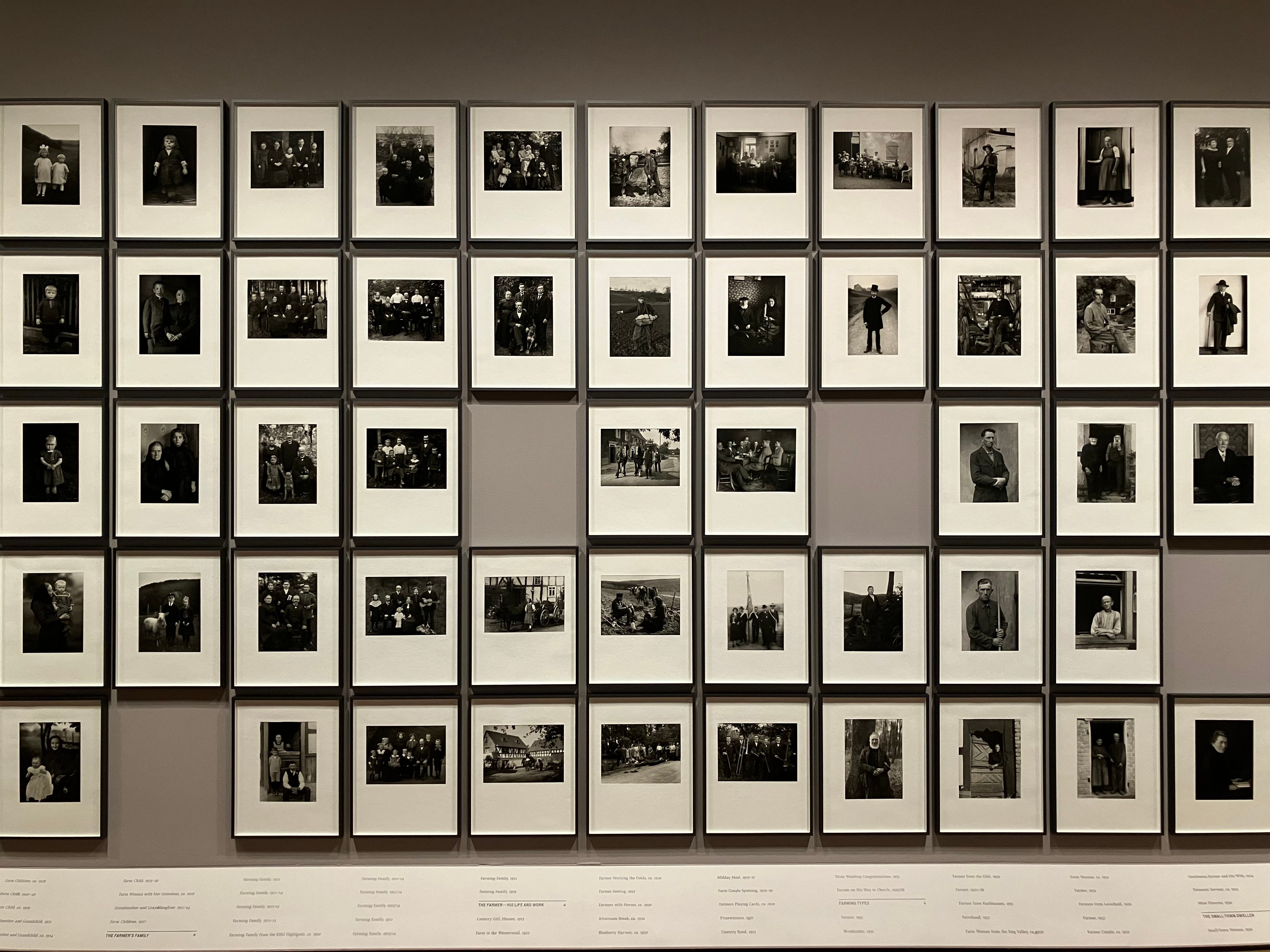
After the tour, I drove further into Connecticut to see the August Sander exhibit at the Yale University Art Gallery.2 Sander is best known for his remarkably humble and outrageously ambitious multi-decade project “People of the 20th Century,” which this exhibit aims to represent in its entirety. That’s 600 photos, arranged in five rows up the walls. From the Weimar 1920s through the rise of Nazism and World War II, Sander made portraits of the everyday Germans around him, organized by demographic type. There is The Farmer, The Artist, The Woman…. Some of them are outsiders. Some of them wear Nazi uniforms. All of them were portrayed with the same black and white simplicity, sometimes in relevant settings or with the props of their “trades” and sometimes completely out of context. Few of the figures are named.
This organization of people into rectangular boxes is aesthetically pleasing, like Johnson’s house. But the grid is also intrinsically controlling, like Johnson’s house. Classification was an infamous Nazi project too, with visible signals. Taxonomies have been notorious tools for oppression. At Yale, the photographs were exhibited with little commentary, and with noticeable blank spots. The breaks in the grid (seen in installation view above) signified changes in categories, like when The Master Craftsmen becomes The Industrialist. The rhythm of these broken lines mimic the lovely asymmetry of the group portraits, and keep the grid from becoming too rigid.
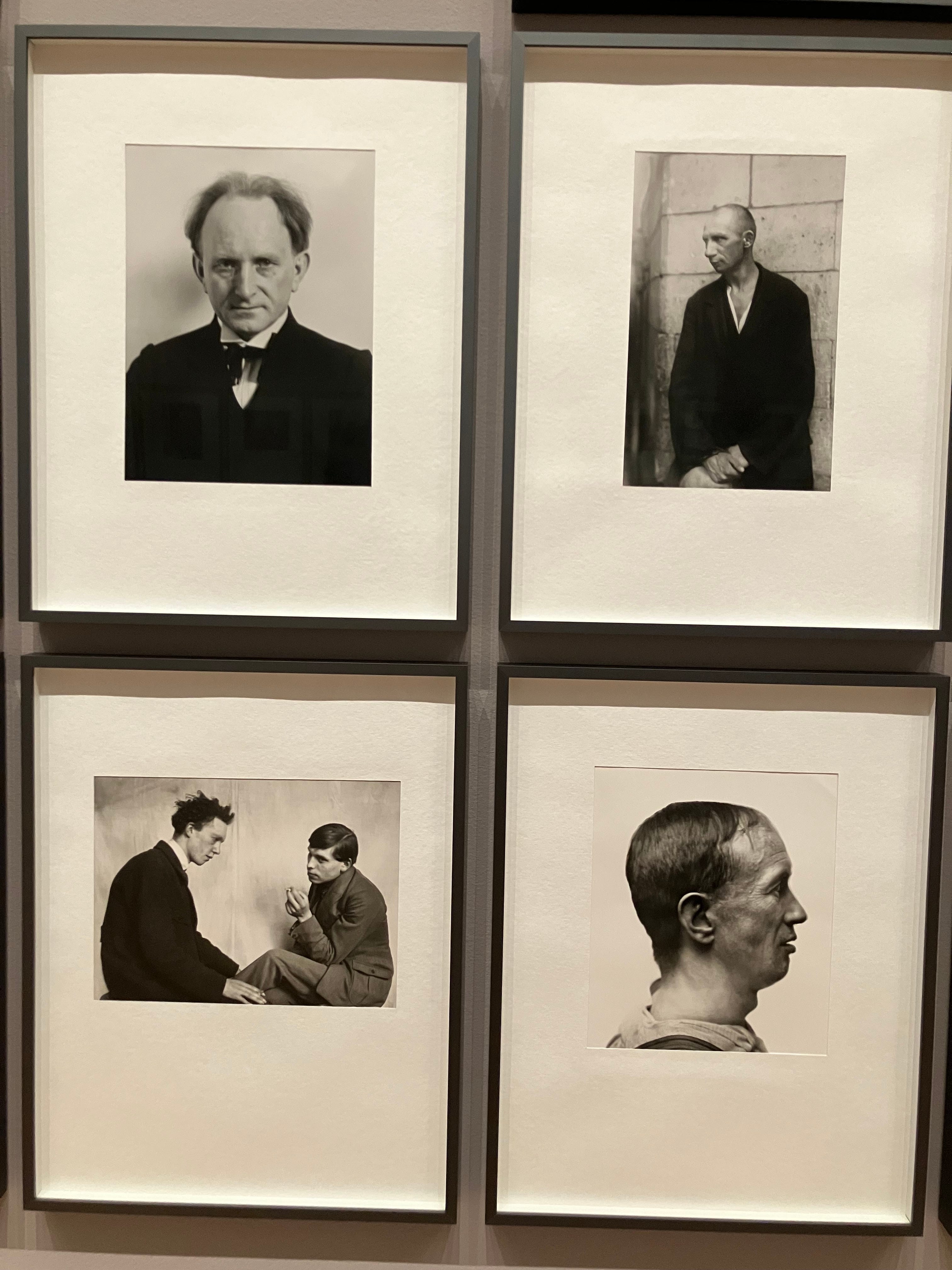
Most of the figures return our gaze. They know they are posing for or as something. Even Sander himself models as “The Photographer.” “Criminal Type” (above) shows the risks of using taxonomies in ways that could dehumanize people— and that could have practical and political implications for the individuals thus labelled. Sander also photographed Jews and political prisoners through the Nazi era. Some of his work was confiscated and destroyed, but he kept at it. In sum, the project has a sort of elegance too— like Johnson’s house— but one that encompasses multitudes. Sander made a life’s work of this obsessive documentation; he made a life of lives.
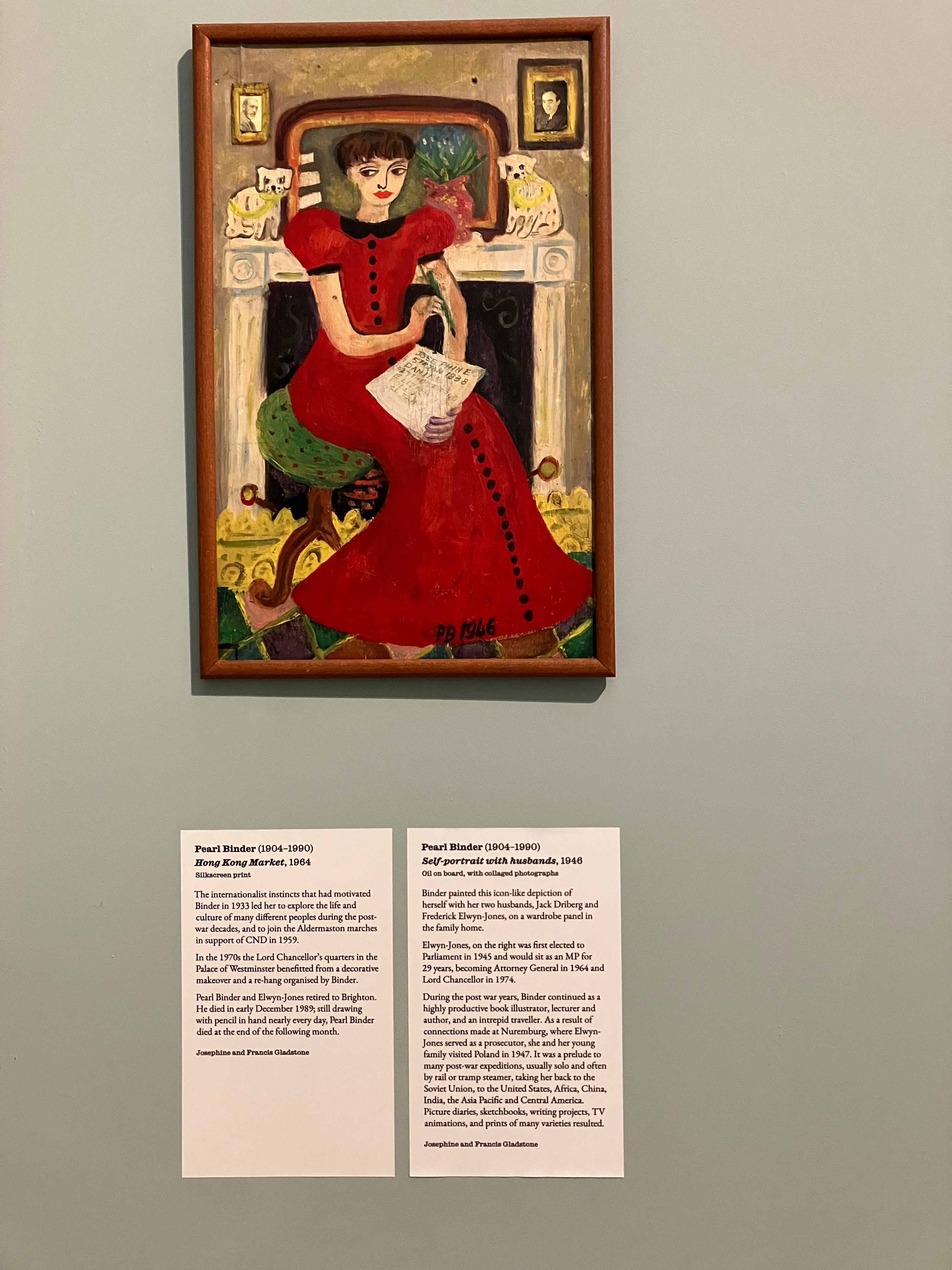
Art can be a screen that obscures the life of the artist. Or the life of the artist can overshadow the art. In England in June I also went to an exhibit on British Anti-Fascist artists at the Towner Gallery in Eastbourne3. In that case the artists self-identified through an organization, the Artists International Association. There’s a risk of dogmatism in such shows, but I enjoyed the exhibit and learned a lot. Pearl Binder4, for example, offered a completely different approach to an anti-fascist life and art: her self portrait incorporates images of her two husbands, one of whom was a British politician who helped prosecute war criminals at Nuremberg. In contrast to Sander’s category “Woman,” here we see the woman artist herself, in disruptive red, flanked by miniaturized men as photos on the wall. Her long diagonal figure interrupts all the squared off shapes behind her, and her side eyed glance seems to say it all: the personal is political too.
Art and the lives of artists certainly don’t always line up, and I usually try not to force them. These three random examples, united by three exhibits seen over a few weeks, have little in common besides history so I will stop here before pushing too hard. I so appreciate you reading to the end! Please leave a comment and I will respond.
Thank you to my sisters for the tickets to see this! It was a much-appreciated birthday present.
I apologize that so often I write about shows that have already closed. I am very behind this summer: first because of travel to the Camino in Spain and now because my mother fell and my sisters and I are managing her rehab. She is recovering, thanks, but slowly.
This show, at least, is still running! Through October 18th if you are near there.
I looked for Binder because I have been reading Sarah Harkness’s posts on her work in progress about wives of mid-twentieth-century British politicians. The biographical background in this piece makes wonderful reading.
Argh. Missed the Sander show at Yale! But it’s never too late to visit the Glass House. I live 15 minutes from this marvel and am ashamed to say I have never visited. Next time you are up my way you should drop by! ; )