
The Ways
A pilgrimage of sorts in Spain

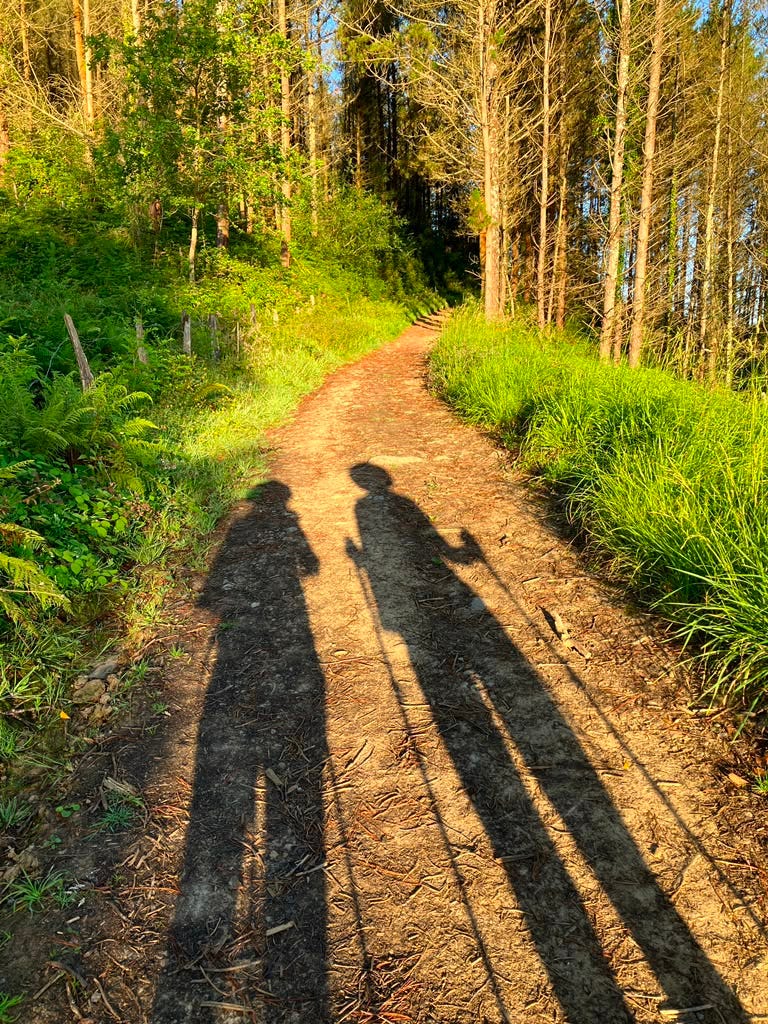
There are many paths along the Camino de Santiago de Compostela. This month I walked one week of the northern route, and even there the paths are varied and winding. Yellow arrows pointed the way at each intersection. It was well-marked and literally well-trodden, having been a pilgrimage route for centuries. I was on a beaten path.1
It was not explicitly a spiritual journey, except in the sense that one of my goals was getting to see the Guggenheim Museum in Bilbao. Art was a religion in my family, and I could do this with a sister.


This first stretch of the northern Camino—from San Sebastian to Bilbao— was harder than I realized, even though I was warned it would be hard. My sister and I climbed and descended ridges every day. Big ones. I could look up the elevation but the numbers don’t mean much to me (is 400 feet high? 1500 feet? what percent grade is steep? I have no idea). I walked up long inclines sweating until my hands slid off the walking poles. I walked slowly down gravel trails, leaning heavily on each pole. My knees held. Altogether, we covered about 75 miles in seven days. We were very lucky in the weather— with only brief batches of light rain and only one or two days of real heat.


The routes shifted from paved park roads to rocky trails to dirt paths. Some stones were smooth and well worn; some were rough and jagged, and would be treacherous in mud. We walked along waterfront promenades and through farmland. We fed an apple to a horse. Sometimes we shared the road with cars. Once we emerged from a forested detour and had to hug the shoulder of a curvy mountain road, hoping there were no cars coming fast around the corner. Sometimes we walked down a ridge into a town that had elevators between street levels. There were many original fountains, still supplying potable water to thirsty pilgrims. We passed churches, stayed in a convent, and found a soda machine at the top of the long ascent into Bilbao.


We booked small hotels for the cities and stayed in hostels along the route itself. The hostels were run by generous volunteers, who handed out disposable sheets and pillowcases, first come first served. In Gernika we went to the Peace Museum; in Bilbao we went to the Guggenheim. But in general we had no time or attention for attractions. We walked and slept. Even eating wasn’t as easy as expected. Croissants with cafes con leche for breakfast and bocadillos and pintxos for dinner; any other food wasn’t served until past our early bedtimes.


My photos purposely avoid the people, to protect their privacies. There were other pilgrims on the road but not many in this season. We’d pass maybe 8-10 people a day. Or rather, they would pass us. We were slow.


The walk was a construction, a series of steps meeting a set of stones. A step is a unit of the body; a stone is a unit of the world. Together they created a meandering way of being, not verbal but not entirely physical either. A meditation, people say, but if so it’s a particularly inarticulate one. I “thought” on the camino but in no particular direction, without words. It might be more accurate to say I felt— the variety of ground beneath me, the leafy-floral smells of each terrain, the sounds of birds and animals, the strain of my own body. And I did this alongside my sister, in a sort of collaborative communion.


The trip made me muse about how specific relationships are in time and space. My sister and I hadn’t done anything like this together, exactly. We were not a sporty family. But this walk layered over our adolescent trips to Europe, our family reunion in southern Spain several years ago, and my trips to visit this sister when she lived in France. Once she and I drove from France to Italy together (she drove, I passengered). The seaside dinner is a delicious memory. This trip added a new brick to the foundation wall of our relationship. Each brick is unique. Every brick counts. This time in this place was itself and irreplaceable.


I have more to say about all of this. I want to write about being inside that Guggenheim, about the professional trip that preceded it— a research trip to the Isle of Wight for a Julia Margaret Cameron conference, about my love of London and building onto my friendships there. Maybe I can quote from some of my journalling at the time, if it’s presentable enough. I’ve returned full of impressions and visions and words, waiting for a turn to get out.
Til then, thanks for joining me. Please comment or share any of your thoughts. I look forward to reading and responding.
Related posts:

In searching my own archive I find that I have used pilgrimage several times as a metaphor for my research into my father’s art career. Specifically, I call my trips to find my father’s artworks “pilgrimages” here and here and here. In this post I describe a trip to the Whitney Museum of American Art, with this same sister, in the same terms too. I suppose I want to evoke a spiritual and emotional element to these journeys, convey them as impactful and meaningful, but also universalize them as more than just personal.
I enjoyed this walk on the Camino. I did not realize it was a challenging hike. For some reason I thought it was an easier walk, maybe due to the number of people who make the trek.
Sounds like a great trip. I love seeing so much green in the pictures and interesting to read about how the path itself changed along the way.