
Housekeeping
The white wall as blank page.

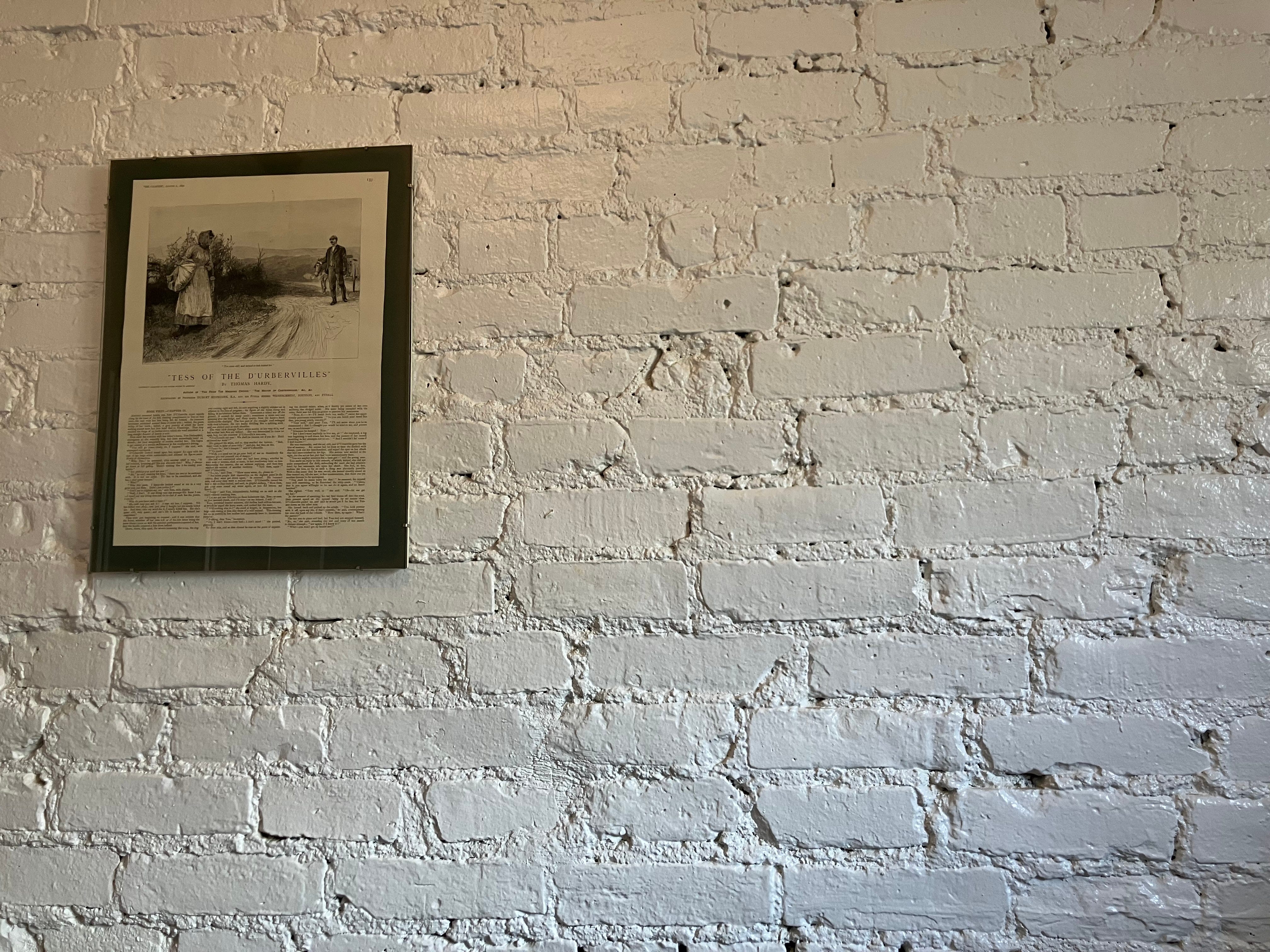
At a recent webinar I realized that all the other authors online had appropriately book-ish backdrops, with curated shelves highlighting their books, facing out. The wall behind me, in contrast, is white brick. When taping a podcast yesterday, I could just see the edges of a framed illustration from a Victorian periodical. Let’s look at it more closely.
It’s the front page of Chapter IX of Thomas Hardy’s Tess of the D’Urbervilles, illustrated by Hubert Herkomer for The Graphic (August 1891). In it, Tess meets Alec D’Urberville on a rural road in Hardy’s Wessex. When I pause to read that section it’s disturbing. Alec persists in driving the cart they are in too fast down several hills, over Tess’s objections. He insists on a kiss: “He was inexorable, and she sat still, and D’Urberville gave her the kiss of mastery.” It is a concise foreshadowing of the plot ahead. Is this what I want visible behind me in every video call? The section ends with quick-witted Tess managing to get out of the cart, but the page on the wall can’t be turned.
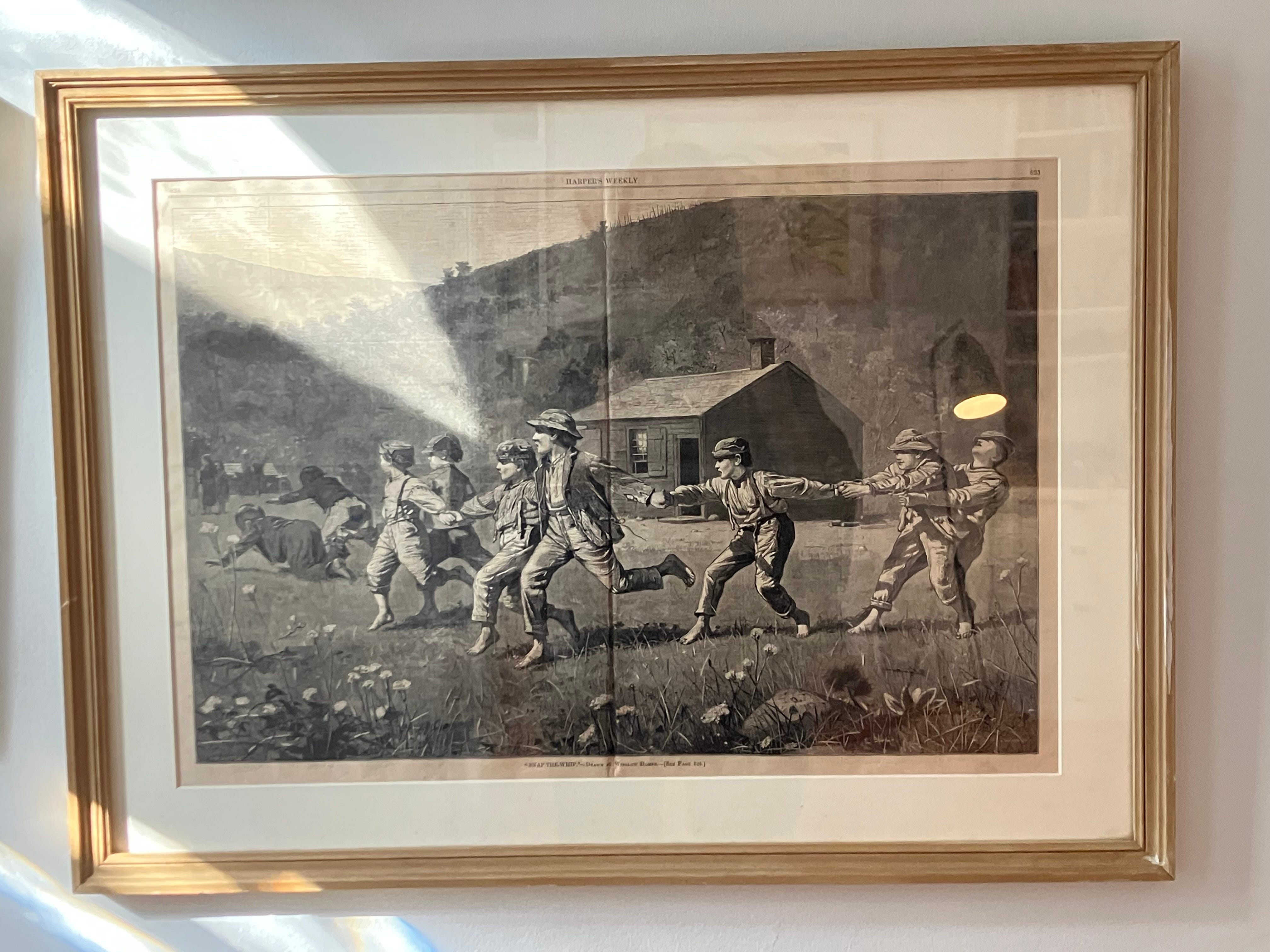
Growing up, on weekends in upstate New York, my sisters and I spent a lot of time with our father at antique stores, thrift stores, garage sales, local auctions, and flea markets. We were not about Antiques Roadshow: we did not really care about value or connoisseurship. We just like to sift through junk for interesting objects. My sisters and I wore a lot of vintage clothing and we loved costume jewelry. I was always especially drawn to the books sections, but as I moved toward literary studies I looked for early editions of the nineteenth century works I was reading in classes. I ended up with lots of cellophaned issues of Harper’s Weekly, for example, because that’s where you’d find now-canonical English authors in their American versions.1
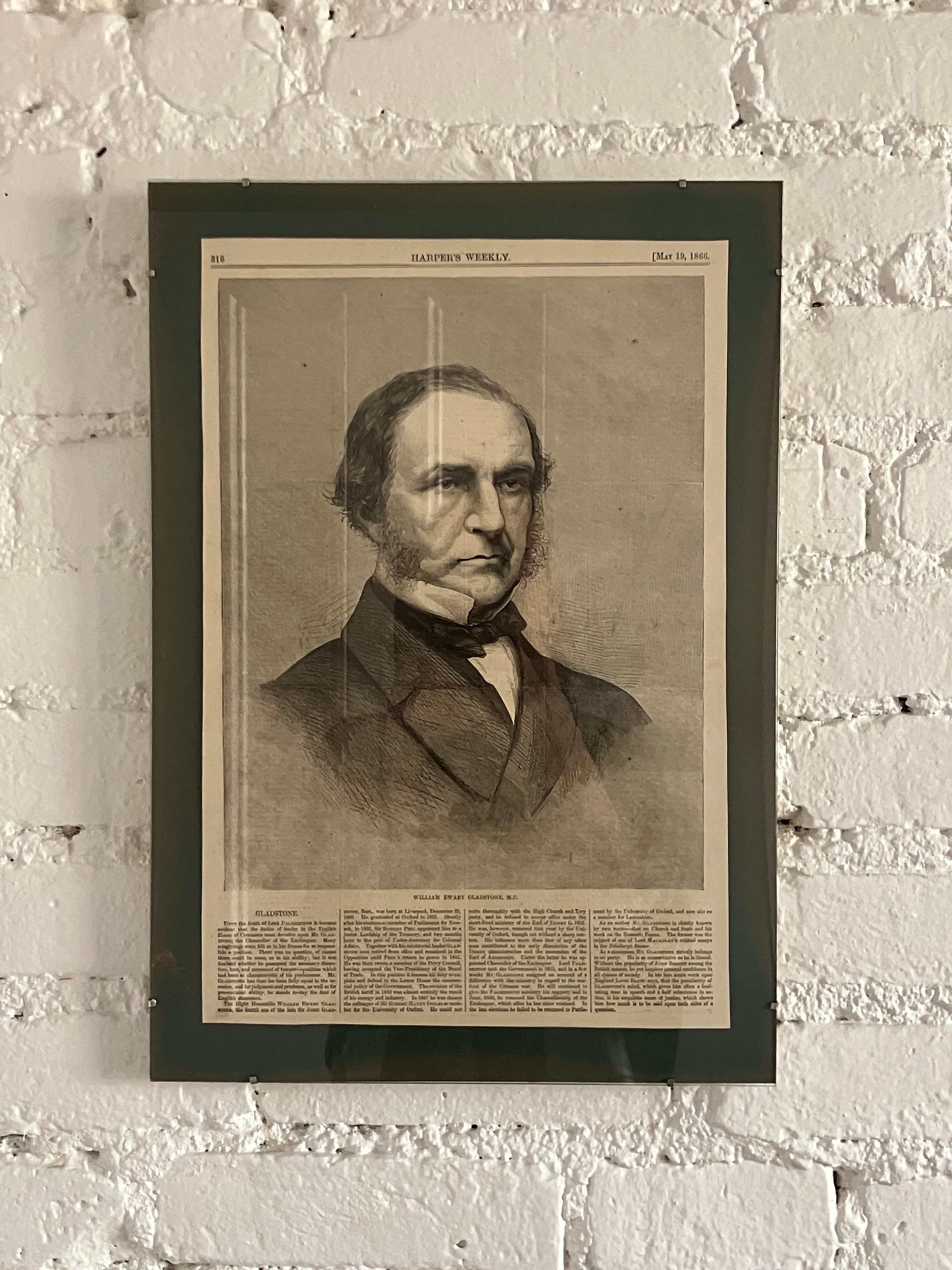
The other image on my office wall was also chosen for visual impact, not symbolism. It features the craggy fine-grained face of William Ewart Gladstone, from an unsigned Harper’s profile in 1866: “Upon the death of Lord Palmerston it became evident that the duties of leader of the English House of Commons must devolve upon Mr. Gladstone, the Chancellor of the Exchequer.” I love that opening for its declarative rigor…what is evident and what must devolve. The sentence itself is a smooth hand-over of power. It has little to do with me or my work, though.
What else could I use as a backdrop — that might signal something about my preoccupations? It would make more sense to have my books lined up behind me. But my office is narrow; a bookshelf behind me would impinge upon my desk space. I could hang an image by Julia Margaret Cameron, the subject of my biography, who certainly has plenty of arresting images to choose from (“I longed to arrest all beauty that came before me,” she wrote, memorably, in her memoir). I have a framed image by Cameron in my basement, but it feels like too much to me. Too on the nose. In the hermeneutics of my office it is overdetermined. Besides, I don’t write about Cameron any more.
Is this an abstract problem of self-definition or a decorating problem of logistics and dimensions? These are questions of curation and installation. Here are some other contenders for this valuable real estate, this white wall, behind my desk:
one of my father’s antique store finds: a framed marriage certificate from Lansingburgh, NY, 1888. The black and white faces are strangers, but I should look at some genealogy sites to see if I can find their descendants. Who wouldn’t love to add this amazing document to their family archive? The photograph below includes some reflective glare that I find interesting too.
a collage made for me by my adult child for a birthday several years ago. It is archival in some ways, and meaningful to me. The reverse is signed in all caps: “LOVE YOU, MA! SORRY IT’S SO SHINY & HARD TO SEE…HA.” It’s about the same size as Tess and would replace her nicely.
a photograph by my photographer sister, also a gift. She made a collage out of previous photographs and rephotographed them with paper cutouts. “Shaping the narrative” would be an apt reminder of what my sisters and I all do, as I do it.
a page from a Biography of Distinguished Persons, with overlaid octopi. This would evoke my background in biography, but a little whimsically. The rippling plastic cover looks uncannily like foliage, but that’s an illusion of my photo.
a print of a photograph from the New York Public Library’s Picture Collection, perhaps deaccessioned and picked up by my father. Attributed to Degas, it’s a group of Parisian friends in a park. It intriguingly claims that one of the men in the image was a model for Proust’s Swann, but I haven’t confirmed that. None of this is particularly relevant for me or my work, but I like the randomness of it— and the immediacy of these 19th-century figures looking back at me.
a glass negative portrait of me, made by gifted photographer Magda Kuca a few years ago when I took her studio workshop in the wet collodion process. This would need special framing to be more visible against a dark background.


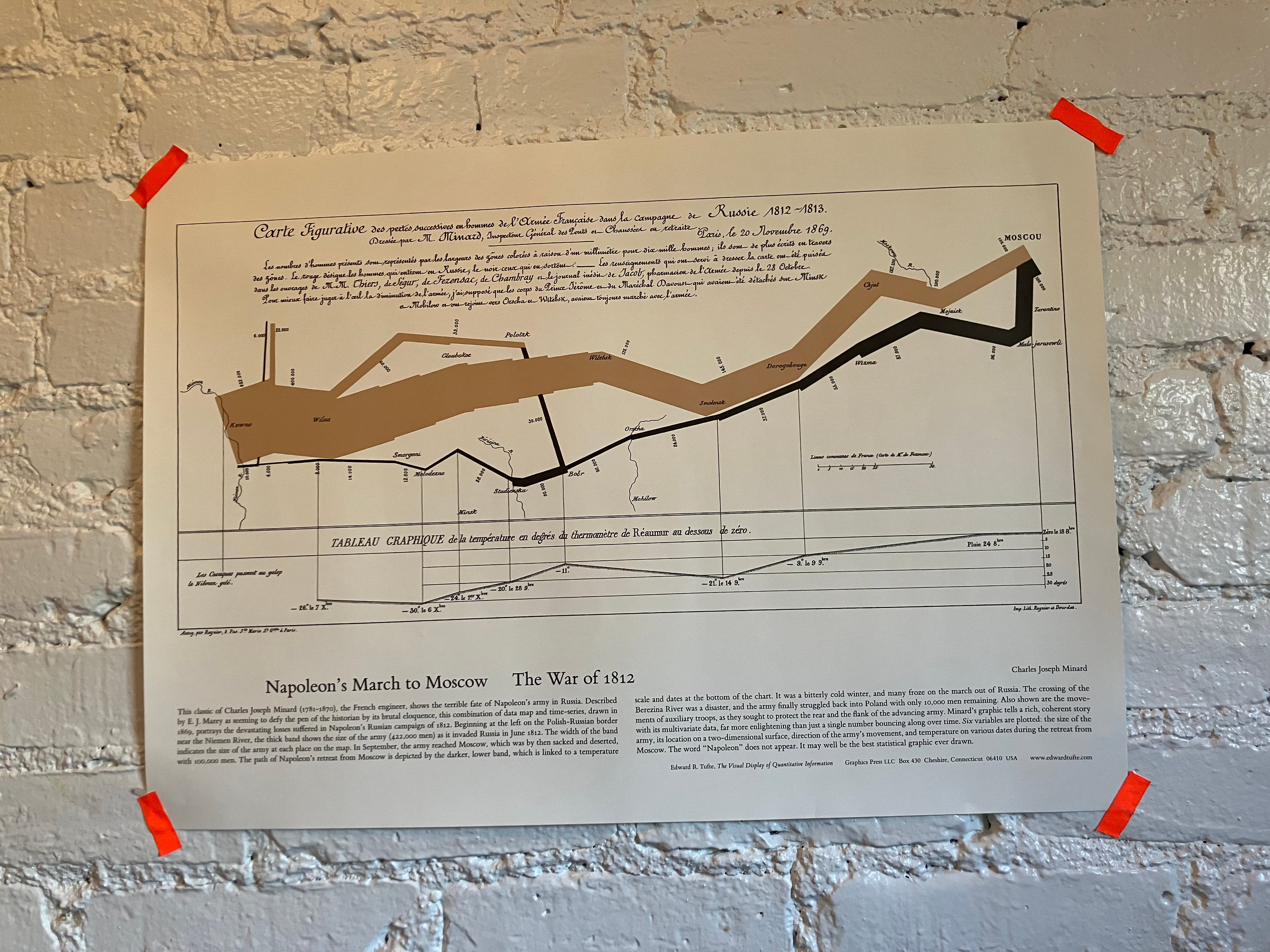
Here’s one last option for your consideration, Charles Joseph Minard’s famous 1869 visualization of Napoleon’s march into Russia in 1812 (via Edward Tufte). It’s a wonderful map as well as a genius depiction of the ill-fated campaign — the river of brown represents the soldiers who marched in, while the dwindling black line shows those who survived to walk out. I referred to it often while reading War and Peace last year. (This would be a humbling daily reminder against hubris!)
Now that I see these images all laid out in gallery view, I think I will make a grouping of some of them: at least the piece by my child, my sister, and the glass me, as a counterweight to the patriarchal narratives behind me now. Those go together well visually too, with their shades of black and gray. I can leave Gladstone up and give Tess a rest for awhile; she’s tired. Of course my choices aren’t limited to these, but I like the idea of starting with what I already have at hand. And maybe rotating more frequently.
My white wall is a blank page. And it distracts from the gaping grave-sized holes out front as our sewer lines are replaced. As I open the year by revising the memoir of my father’s art career and drafting the sequel to the Victorian thriller I wrote with Christina Boufis, I am looking for distractions, eager to procrastinate. But this re-hanging is also a way of re-entering the past, maybe: both the long nineteenth century and my own archive. What are your thoughts? What is the logic that should go into these choices? It’s a desk-cleaning, re-organizing time of the year. Do you have rituals for it? Leave them, and any advice for me, in the comments. Thank you! 🙏
Harper’s was known for its illustrators, most famously Thomas Nast, who chronicled the corruption of Tammany Hall with satiric wit, but also others as well. You can find Henry Mosler’s Civil War images from the Smithsonian Archive of American Art here. My father always searched old Harper’s for Winslow Homer prints, and I inherited some of his framed images. They are “originals” in the sense of having been reproduced in original magazines, and I enjoy the crease dividing the double-spread layouts, as shown in the image above.
Well. I find your white wall with the "random" framed piece frankly more interesting than those ubiquitous background bookshelves which might be seen as bragging -- "See how educated I am, all the important books I've read?" and they are all so simlar as well. You have a great collection of other options so I'd consider a rotating display -- but leave plenty of those beautiful white bricks in the background as well. Wonderful post!
I love the Gladstone and the Charles Joseph Minard! Gladstone feels like a political giant now, though, of course, he had plenty of demons of his own to slay.