
What Happened?
Not your usual AI post

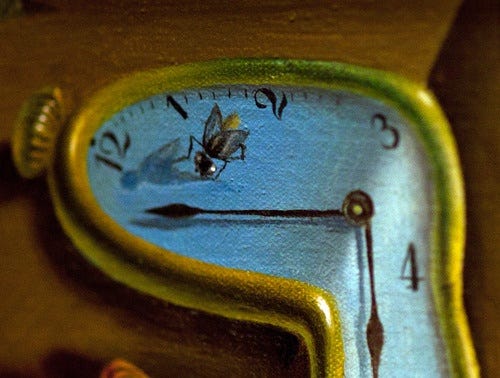
The Comment was not effusive, but it was long— three paragraphs! It read the Substack Note I had posted carefully: it paid attention to the verb I had chosen to describe the fathers in a book and a movie I had seen on a plane. They were “trying,” I had written. I was trying too— to represent these flawed fathers and be fair to them. The Commenter encouraged me to write more and left their email in the Note. I felt heard (an almost-anagram of “read”). I clicked the little heart for the Comment and replied, “Wow, thank you. Yes, that verb was intentional. I’ll also try to email you sometime.” I wondered who she was, this elizabeth who was not among my usual Commenters. She replied to my reply: “That’s even better. I hope you’ll reach out.”
Or that’s how I remember the exchange. It’s gone now.
Of course I checked elizabeth’s subscriber profile. She had published no posts and subscribed to no newsletters. She had no biographical info or interests. Her Activity comprised a series of recent Comments on Notes that read just like her Comment on mine— all complimenting the author on their nuanced writing and including her email address. Oh. I looked up her name on the internet and found a book marketer in India.
I went back to her Comment and could now see the AI in the tone. Someone had run my Note through an algorithm and “noticed” features of the writing, then embedded them in a hook that caught me. Not Someone— “It’s a bot,” my husband said gently. Not a she, an it. “But why?” I asked, puzzled. “What is it selling?” “It just wants engagement,” he explained. The selling comes after.
I felt embarrassed and annoyed. I had fallen for the obsequious AI fan fic that I could easily spot in an email. I just hadn’t expected it in a Substack Comment. How depressing. My vanity can be manipulated, like everyone else’s. End of story.
I was wondering whether to post about my Note and AI when the whole exchange disappeared— and so did elizabeth. Substack erased her without comment, so to speak. And without a screenshot, I was the one who felt like I had hallucinated.
Of course it all happened. But I’m managing memory now, explicitly. If we remember it, it happened. And if we don’t? At 92, my mother has no short-term memory— though her long-term memory is excellent. She not only remembers me and my sisters, she lights up like a beacon when she sees us coming down the hall at the short-term rehab facility where she is re-learning how to walk after a fall. But every time we talk about plans, we are starting over from scratch. She doesn’t remember the last conversation. Decisions, made after careful consideration, evaporate. We are in an eternal present, doing the best we can. This is human.
What’s left are the feelings— anxiety, uncertainty, agitation. Those are my feelings, my sisters’, my mother’s. And they are the cues I add to the AI voice narrator as I work on the audiobook for the novel I co-wrote with Christina Boufis. As indie self-publishing authors, we researched audiobook production— and found that hiring a voice actor to narrate the book would cost ten times more than an AI-generated cast of characters. “Let’s just try it out,” we said to each other, uneasily. And now we are fifty chapters in, correcting pronunciation of character names, adding British accents by class and region, and— yes— adding “emotional cues” to tweak the readings. I explain, hesitantly, ruefully, guiltily. In this strange new world the machine needs me to make it seem human. The AI narration will not sound as good as a human; it may turn off some readers. I admit this, with trepidation.
“You’re taking a job away from a human,” a friend remarked.
Yes. Yes, I am. I have no adverb or excuse for that. I am.
“You should be ashamed of yourself,” a writer wrote me and Christina when we used AI to generate character images for our Kickstarter campaign.
Yes, I am sometimes ashamed of myself. But I am proud of that novel, which Christina and I wrote ourselves—by hand, so to speak. I am writing this piece all by myself (do I have to say that?)1.
I have no grand resolution for this post— except to realize that I am both victim and perpetrator in an emotional and creative economy. I’m implicated.
I want to circle back to that word trying—its sense of effort, even when inadequate, and irritation, at bad behavior. This is a period of transitions and flux, for me, for my mother, for the writing and publishing community. That original Note of mine was about trying fathers, and this newsletter has centered on mine. But there seems no better illustration for this post than my mother working on her walking. She embodies the most concrete, and moving, kind of trying. Here she is, recorded by my sister.
If you are a real human reader, please feel free to comment. I am anxious about this conversation, but I will reply, myself.
Substack’s new Pangram tool, which I had never used before, assured me that this text was 100% human. I feel I need an LOL emoji here but it’s also not funny.
Ugh and wow. I hope AI will never be able to impersonate me, but no doubt it probably already can if it cared to.
I call AI the NOT/IT meaning not intelligent and not even an it. Yours stood for A hole. Keep writing and reading real people and we will survive this yuckyness. ❤️
A really enjoyable read, Victoria. I liked how you slipped in all those emotional cues into the text. And a perfect choice of art to kick off with.
I'm sure I've already had one or two AI-generated comments on pieces and haven't noticed...And one of my essays was turned into an AI-generated "reel" by someone (they were upfront about it and offered to take it down if I wanted. I didn't respond but basically don't care what happens to my words after they have been published).
And I hope your mother's recovery goes well!