
Art, Gender, Language
Frank Gehry, Richard Serra, Jasper Johns, and Denise Scott Brown

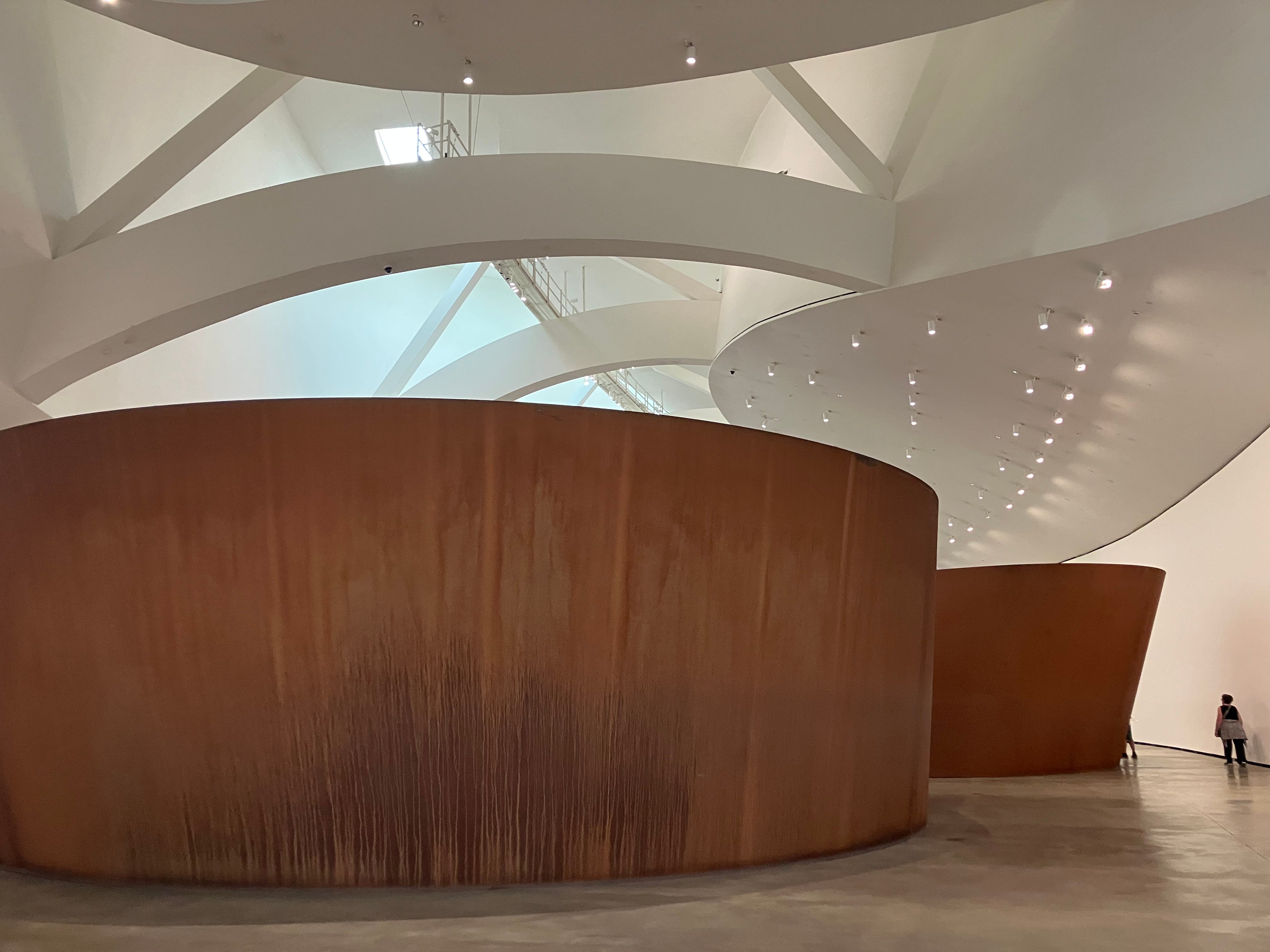
Men Made
At the end of my yellow brick road from San Sebastian to Bilbao lay Frank Gehry’s Guggenheim, bursting like a metallic flower from a concrete jungle. My sister and I made that art pilgrimage the morning after we arrived from our week-long walk there.
Our first encounter was with Richard Serra’s collection, “The Matter of Time.” Serra designed these spirals as a permanent installation for this huge ground floor gallery and, as usual, carefully mapped the walking paths through them as well as the fall of light and shadow. They are dizzying to move through, as you are enclosed by narrow walls and herded through circles. You look up for perspective and meet strange angles and slivered views. You are shaped by the experience.


Beyond that mammoth space is another smaller room with a video of Serra talking about the work. I couldn’t find the video online, but the virtual tour, itself vertiginous, ends there. When I tried to view the film there it stuck on one frame, captioned “te cambia tu propia historia” (it changes your own story). I love listening to Serra talk about his art because he’s a wrecking ball with words. At one point in the interview he says he wanted to direct the visitor’s gaze upward toward the “junk” in Gehry’s architecture. The room is a conversation between visions— both Serra and Gehry work in metal and geometry but seem opposed in tone and feel. Gehry’s flights of aerial fancy face off against Serra’s grounded plain-speaking. When navigating the virtual tour the “camera” perspective swings wildly from place to place. It’s not real, but it does evoke how it feels to be there.
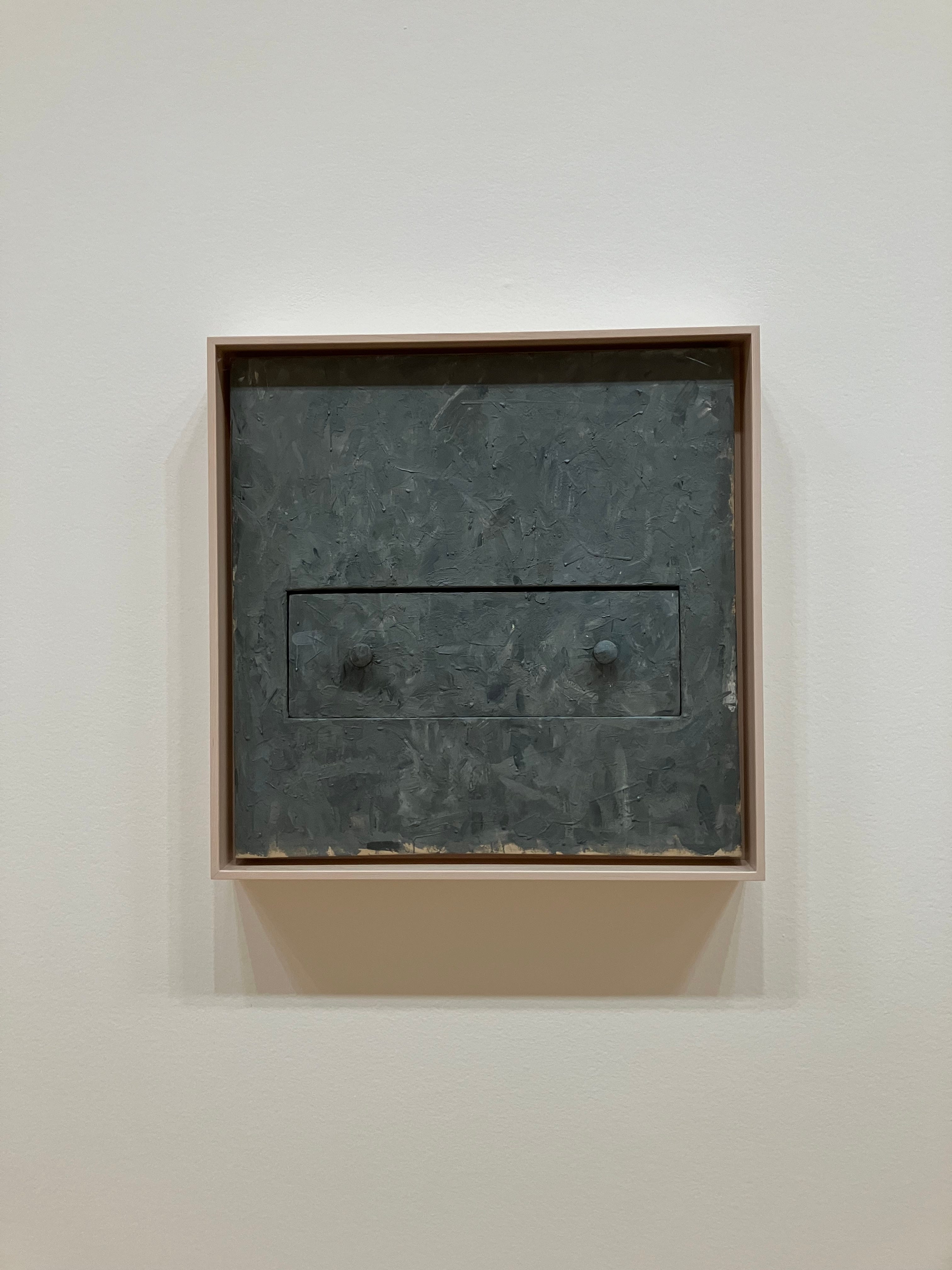
Upstairs, a retrospective on Jasper Johns fanned out from a central glass atrium. You rise up through the center column in an elevator and then walkways lead from one section to another. I didn’t like it. It felt as disorienting as below when I wanted more informational clarity, an omniscient narrator, so to speak. Instead I had a piecemeal view through window slices and catwalks. Where was I? It was hard to tell. That said, once you enter the Johns exhibit all is clear and simple. My sister and I gaped and gasped. We were back in a rectangular white gallery space, and on a grid that Johns plays with in much more familiar ways. The early work in that first room is overwhelmingly, obviously brilliant— even at a glance. A 2D canvas boasts a 3D broom. A painted drawer sports projecting knobs. Stenciled words contrast with expressionist brushstrokes in vivid color. Johns is making and re-making.
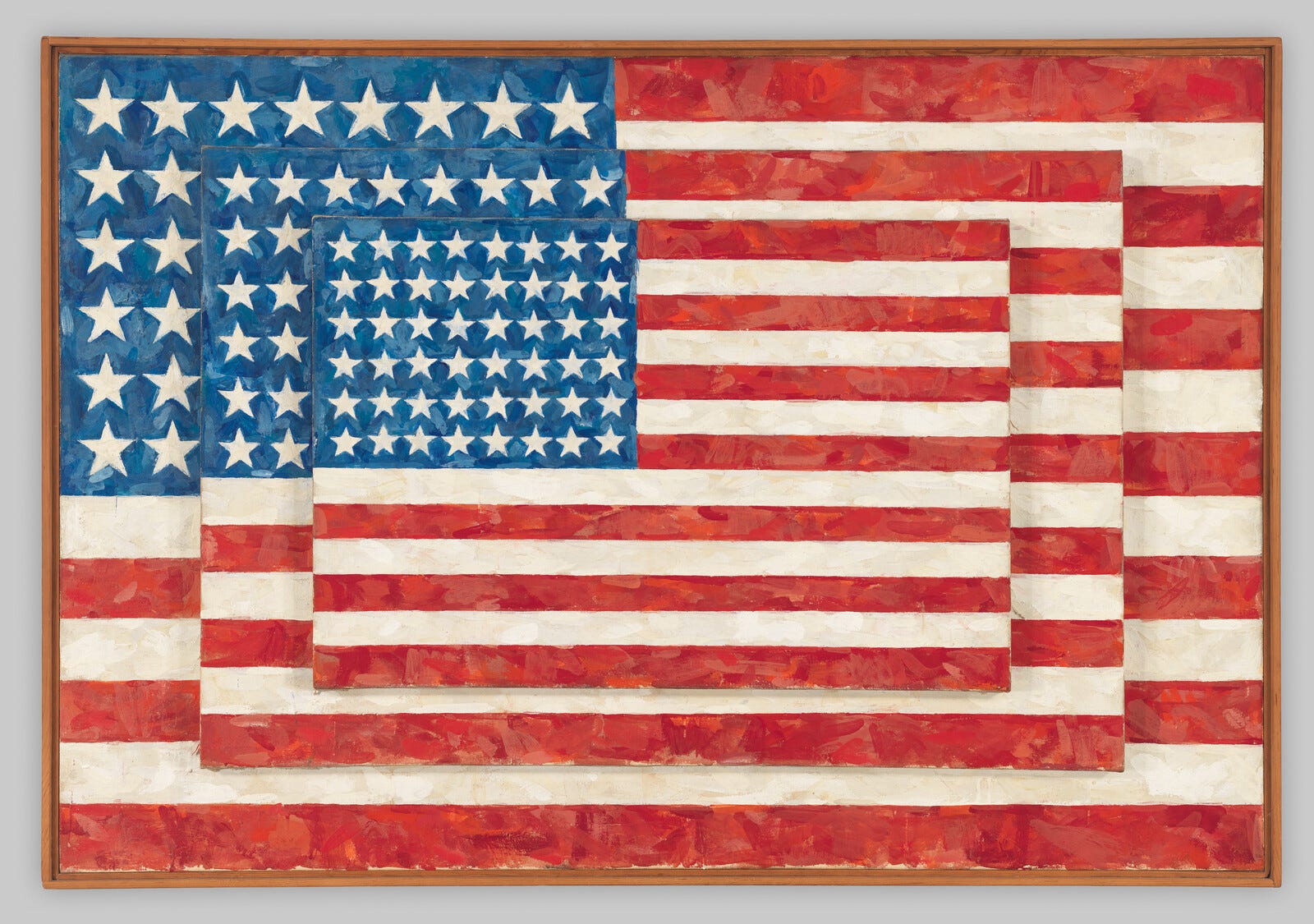
My first and strongest association with Johns is from 1980, when the Whitney Museum of Art paid the then-record price of one million dollars for Three Flags (1958). (Remember when ONE MILLION was a monetary cap in all caps? My father lived in a loft in Dumbo at the time and his landlord offered to sell him the five-story industrial building in the gentrifying neighborhood for one million dollars. My father would repeat “one million!” shaking his head and marveling at the insanity.) As a teenager I wondered about that Johns painting— the simple treatment of an everyday object, three flags in three dimensions, adding up to that then unimaginable sum1. My father would have shaken his head at that price too.
Now, in this American anniversary moment, Johns’s iconic flag feels like a premonition of the kind of rapacious capitalism that has overtaken my country (not to imply that’s all that new). With each layer 25% smaller than the one below, the painting becomes a commentary on diminishing expectations.
Women Making
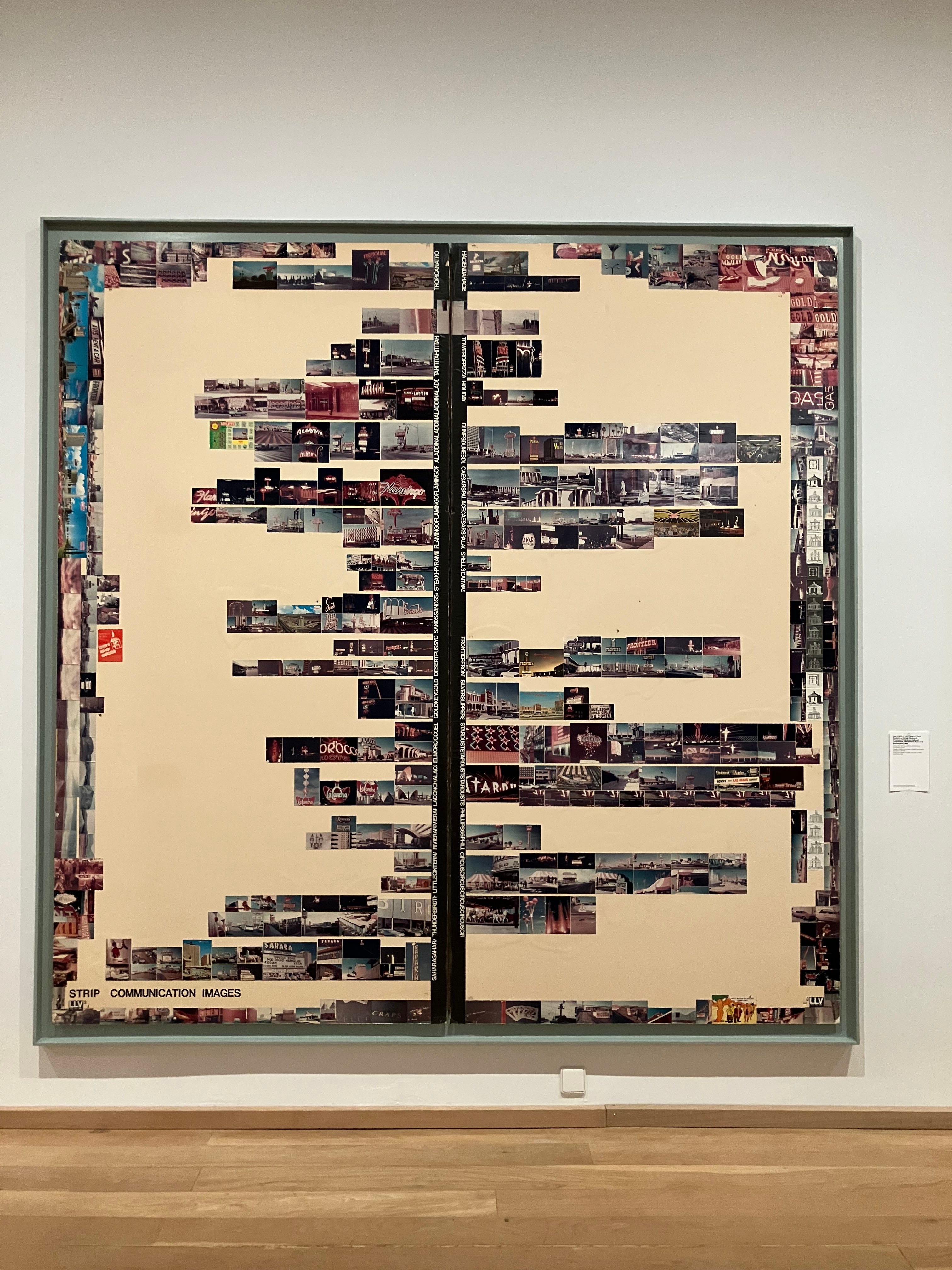
At the Guggenheim Bilbao there was a Ruth Asawa exhibit downstairs but I skipped it because I had seen her retrospective in New York City. The next day at the Museum of Fine Arts in Bilbao I stumbled on an exhibit of Denise Scott Brown’s work. That museum is undergoing renovations and the day I visited it was clanging with hammers and drills. Nonetheless, they mounted a lovely exhibit from Brown’s long career as an architect and urban planner. Her most influential work in Philadelphia and Las Vegas included community use cases and participation from students in graduate courses.2
With works in progress and studies, this show presented a very different model from the more monolithic work by the American men I saw first. A documentary and some wall text offered anecdotal stories from her career, like when she objected to the demolition of a library at the University of Pennsylvania, where she taught. After a faculty meeting where she spoke out against it, her future husband and partner Robert Venturi came over to agree with her. “If you agreed with me, why didn’t you say anything?” she asked him. Overall, the show was fresh and inviting — a good introduction to her voice and eye.
Both museums in Bilbao provided explanatory materials in Spanish and Euskara, the language of the Pays Basque. Uniquely, Euskara is not related to the romance languages of Europe, and it stands out with its frequent use of x, k, and z.3 I found myself comparing parallel texts on the wall, using my bits of Spanish as clues to decipher the Euskara. The easiest observation was that names are inflected in Euskara. When Richard Serra is the active subject of a sentence he is Richard Serrak. To show possession, Johns or Brown become Johnsen and Brownen, respectively, instead of Johns’s or Brown’s. In high school I studied Latin and was fascinated by how cases parsed a sentence for you in ways I had never noticed in English, even though we have fragments of inflection in our pronouns. A subject is in the nominative case; an object accusative. Latin was also gendered, but Euskara is not: its nouns and pronouns are genderless, so Brown, Asawa, Serra, and Gehry can all be described in the same terms, by role. It felt apt.
Thanks for reading, as always— I have a few more pieces queued up from my trip and recent research. I try to thread these posts into something personal or thematic rather than simply conveying information you could get elsewhere. But I am curious about your responses and appreciate all comments. (This piece has already benefited from feedback from my Cape Cod Writers). Til next time!
By the end of the decade it already seemed a bargain: in 1988 a Johns painting set a record at auction of $17 million for a painting by a living artist. In 2010 another Flag went for $110 million in private sale. That’s quite a return on investment for a blue-chip artist.
I am intrigued by the idea of exhibits that focus on artists as teachers, not as “influences” but literally as classroom teachers. The Yale University Art Gallery recently had a small exhibit on Hans Hofmann, best known as a teacher of Abstract Expressionists in New York City and Provincetown. You got to see his own work alongside one emblematic painting of a student: Lee Krasner. Many of the Hans Hofmanns on view were donated by Richard Baker Brown, a Yale alum and art collector whose archives I read while researching my father’s art career. They had overlapping friends and interests in the gay art world of 1950s New York City, but I couldn’t find any definite interaction.
"He's a wrecking ball with words." So good.
I love your approach to writing about art.