
Imperfect Me
An adjective, an imperative verb, --and two scars.

It’s Tuesday. I ran today. I’d post a photo of Brooklyn Bridge Park but the one I took is boring. It’s still warm in New York City and I’m having some minor surgery tomorrow (“a procedure”) and trying to do everything as if this is my last day on earth. I’m like that for trips too— I have to finish everything at home in case I don’t make it back. It’s sort of funny when you think about it.
So while I was running I did some thinking. What would I write about here this week? I’m slow, and I could start with that: how a ten-minute mile is aspirational, how when people say “run at a pace where you can hold a conversation,” I think “there is no such pace.”
But I wanted to get back to my father’s memoir, even though my mind is on the Victorian thriller I co-wrote with
.1 And I should be figuring out social media, and posting enticing content that will connect with potential readers. I really have no idea how to do that.My husband: “Just talk about the book.”
Me: “What?”
Him: “Like why you wrote it. Your research. The history. That’s interesting.”
Me: “You mean, to myself? Like, while looking at my camera phone?”
He just looked back at me so maybe yeah, that’s how it’s done.
I guess I could just not be good at it and leave it at that. But it *would* be nice to learn something. So this week I sent out a newsletter to our web subscribers and Christina and I worked on another update for our Kickstarter backers. But writing is the easy part. It’s the photos for Instagram and the videos for TikTok that baffle me.2
In trying to connect this back to my father and my memoir about his art, I thought of a line in one of his sketchbooks that I quoted once already in another post. “BE— NOT PERFECT—,” he wrote. “NO ONE IS.”3 (I had trouble finding that post. I lose things. I break them. I forget.)
And this led me to the evergreen theme of imperfections.
It’s Wednesday during the dermatology surgery (no, “the procedure”!). The stitches tug at the skin on my face, and I remember this feeling. String being pulled through the skin under my eye. And there *is* a connection to my father and the memoir because I wrote about this memory there, but I’m not sure if I have mentioned it here. It’s this:
POINT OF VIEW
I’m looking at myself in a bathroom mirror and there’s blood all over my face. Is it a memory or a reconstruction of a scene? We lived in Englewood, New Jersey. We had a housekeeper, the word we always used for the women of color who took care of us while my parents worked. I was five or six years old. I was playing with my sisters and our dog Muffet. I threw a blanket over Muffet’s head and she came up snapping, biting me under my left eye. “The child could have lost an eye!” people said. I remember this story. The scar is very faint now, but still visible.
At the hospital, my mother would say, my father had the presence of mind to ask for a plastic surgeon to minimize the scarring on my cheek. We gave away the dog. I remember my sisters asking “can’t we give away Vicky instead?” Shortly afterwards, we moved back to New York City and my father moved out.
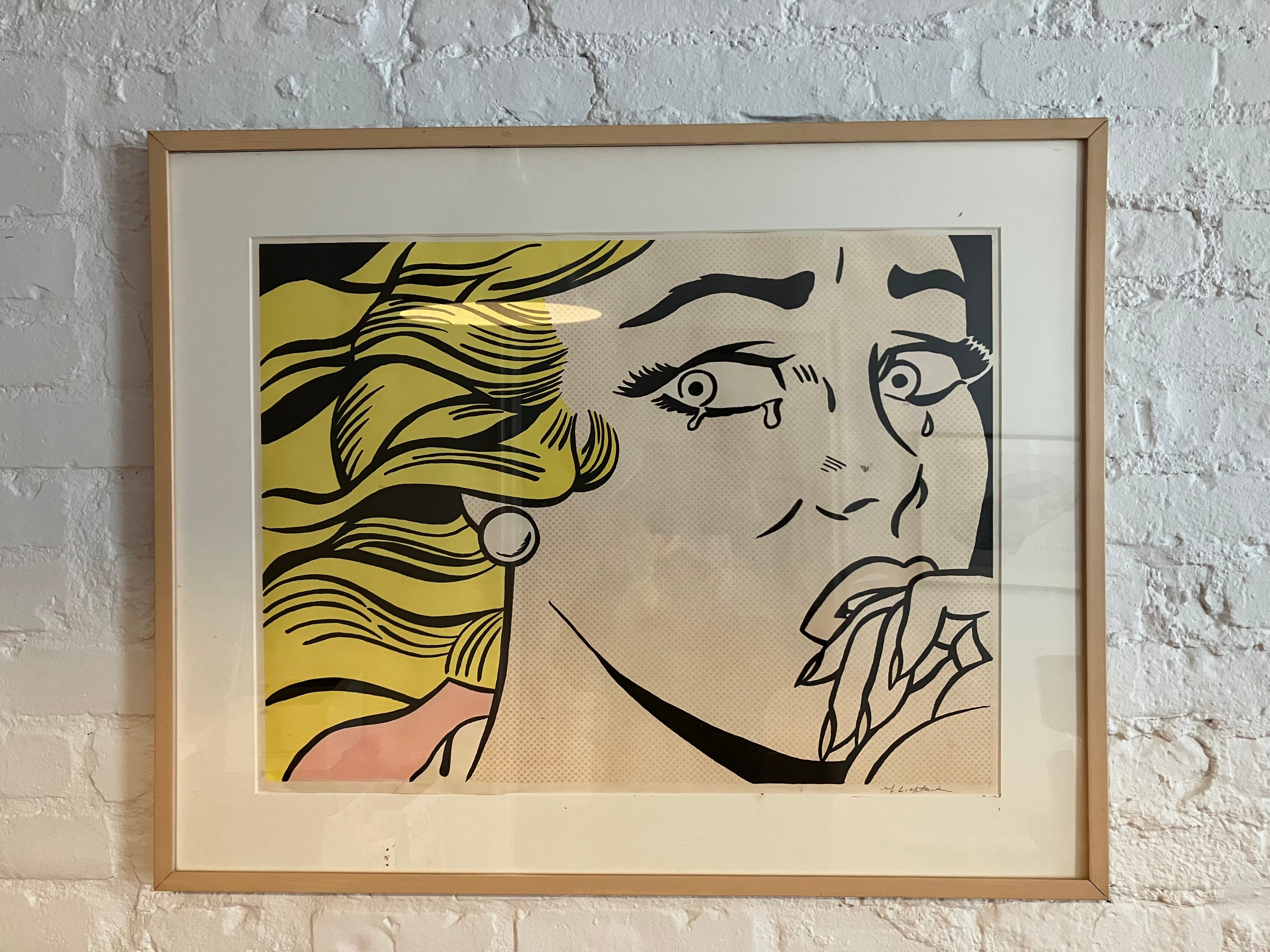
That early memory of my child-self in the mirror was scarring, despite the plastic surgery. Even before my father left my mother I understood that it was possible to behave badly and get pushed out of the family circle (like Muffet!). I understood in some gendered inchoate way that my appearance would matter more than my voice or my thoughts. Now that memory reminds me of the famous red room scene in Jane Eyre; it signifies the inarticulate pain and rage of a powerless little girl. My father owned a signed print of Roy Lichtenstein’s Crying Girl that I inherited. It still hangs in my kitchen, visible every day. I used to use it every September as the background when documenting my younger child’s first day of school. When we were children my sisters and I poked holes through its ben-day dots with a pencil, another sign of silent aggression.
The fact that my father recommended the plastic surgeon always seemed significant to me. He believed in appearances. His daughters were supposed to be pretty.4
It’s Thursday and I’m taking off the bandage on my right cheek. The other one. The scar under my left eye from the dog bite is barely a white smudge, but it had decades to fade. This one won’t have nearly as many. There’s a black line of Xs across my cheekbone. “Like Frankenstein,” I tell my sisters, and send a photo.
I thought of including a photo here too, but think that’s too much, too sensationalizing. Instead I’ll try to convey the feeling of discomfort, the queasiness as I look at my own face, my feelings leaking out through my eyelids— not quite crying, just seeping. Everything went fine; all is well. There’s no reason to be emotional about any of this. And yet. It’s my face.
Our faces are ourselves, aren’t they? The “heart” is invisible and buried deep inside. The “soul” is even more abstract. But our faces represent us to the public, though they change so much over time. My face has always felt unfamiliar to me, when I see it by accident (that’s not me!). But it’s still my public banner, my advertisement to the world.


Here is another version of my face, which I have also shared before. My father painted it when I was about five, just about when our dog bit me. When I went upstairs to look at the painting again (and photograph it, along with the Lichtenstein above) I noticed the crescent-shaped glob of white paint exactly where my first scar was, though I doubt that was intentional. Come to think of it, it can’t be. That’s my right eye, where the new scar is, not the left eye. The painting is a mirror image, of course. I was destined for these marks.
This memory—the written account and the painting and the sensory feeling of tugging on my face—reminds me of being in my child’s body. I was always bad at estimating measurements so when I was young and needed to know a size I’d check the length of my nose, which was (I believed) one inch long. By that metric, my new scar is two inches long; my nose is longer now. And the new scar is not actually a line of black Xs, as I said above, from memory. When I go to measure it I realize it is a line of short straight hatch marks. It always pays to look again.
I want to be a person who shouts out the wonderful work the people around me do. To that end, here are some recent treats:
- ’s autobiographical essay “No Seatbelts” for . It includes two visions of two men and explores new territory for this travel writer. I loved it.
- ’s new book on Emerson’s Daughters, Ellen and Edith. I’ve heard Kate speak on this topic several times and her book brings these very different sisters to life. (And yikes, I too am a daughter tending a father’s legacy.)
I find that the Substack pieces I share the most often with other people are from
’s Wondercabinet. I love his essays, and used to teach them to Tisch students at NYU. These pieces are LONG— not at all in the usual Substack mode—so I often email them to friends instead of re-posting. Consider this a little fan-girling.
Thank you all for your continued presence here on my modest (imperfect) newsletter! Please let me know what you are doing and thinking and whether you have scars that have made you rethink or re-see your own face. <smiley face>
That is, Some Dark Force, which I wrote about here. Today is the last day of the Kickstarter campaign, which has gone well! Thanks to friends and family and new readers who backed us!
For this last day of the campaign I figured out how to create a reel on Instagram! (So many exclamation points!) I am still not sure of the differences between a reel and a story but I think I have now made both. I think. If you’re curious about the results check out my Instagram here. Christina posts funny (book-related!) videos on our TikTok here.
Should I have titled this post “Be Not Perfect?” Yes? No? It’s a strange phrasing, isn’t it? Like a line from Shakespeare or something? An ode? I decide I like my self-made verb instead. If “to perfect” is a verb, why isn’t “to imperfect”? The stress could move to the last syllable too.
VANITY is a word I don’t use anywhere.
This is so good and beautiful and vulnerable. Thank you for sharing it.
Thank you for the shoutout Victoria! I loved reading about your process. (Did you know Etta & I have been in a writing group for a few years now? So nice to see us together in this newsletter).